A steady, level deck, room for a whole party and a shallow hull for sandy bays: why groups and families choose a catamaran charter in Mallorca, how sailing and power catamarans differ, and how our two catamarans compare.
Groups and families choose a catamaran charter in Mallorca for three reasons: a steadier, more level deck, far more space to share, and a shallow hull that can approach sandy bays where the depth and the rules allow. Two hulls set wide apart resist rolling, so a catamaran sits flatter than a monohull, and a large party can talk, eat and swim from a single platform. At Serman Yacht Charter we take that idea to its fullest: our two sailing catamarans are listed for up to 45 and 65 guests, and they are built for celebrations, company days and family gatherings at sea.
Two hulls, a steadier day
A monohull relies on a heavy keel to stay upright and leans, or heels, when the wind fills her sails. A catamaran takes its stability from width instead: the distance between the hulls resists rolling and overturning without any ballast. Sailing guides note that a catamaran heels far less than a monohull, and that sailing flat can help to avoid seasickness. A yacht broker who favours catamarans adds that they do not roll at anchor the way a monohull can, which counts over lunch in a bay.
The motion is different rather than absent. The same publications point out that a catamaran can have a quick motion in heavier weather, and that in light winds some guests may still feel unsettled. If anyone in your group is prone to seasickness, the NHS advises sitting towards the middle of a boat, looking at a fixed point such as the horizon and breathing fresh air, and a pharmacist can recommend a remedy before the day. A sheltered route, chosen by the captain on the day, also helps.
Room for everyone on one deck
Width also creates space. On a cruising catamaran the saloon spans both hulls, and sailing guides describe more room on deck and inside than on a monohull, often with no steps between the cockpit and the saloon. A level deck makes moving about feel natural, which is the whole point for a group: people mingle, and the buffet and the toast happen with everyone in one place. A boat that sails flat still moves, though, and one catamaran designer reminds sailors that a hand on a rail is never wasted.
Shallow draught and the coves
Without a deep ballast keel, a catamaran draws less water than a monohull and, in Yachting Monthly's words, can get much closer in. In practice that can mean anchoring over a patch of sand nearer the beach, with a shorter swim or paddle to the shore. Many catamarans lie to a bridle rigged between the two hulls and swing differently from monohulls at anchor, so the captain leaves extra room around neighbouring boats.
Closer in never means anywhere. Under Balearic Decree 25/2018, anchoring on Posidonia oceanica seagrass is prohibited as a general rule, so the captain looks for sand or uses a buoy where one is installed. Spanish coastal rules also protect swimmers: navigation is prohibited inside buoyed swimming zones, and where a stretch of coast has none, the regulations treat a strip 200 metres wide off beaches and 50 metres wide off the rest of the coast as a swimming zone, with a speed limit of three knots. Our guide to Posidonia and anchoring explains how captains read the seabed.
Trampolines, foredecks and swim steps
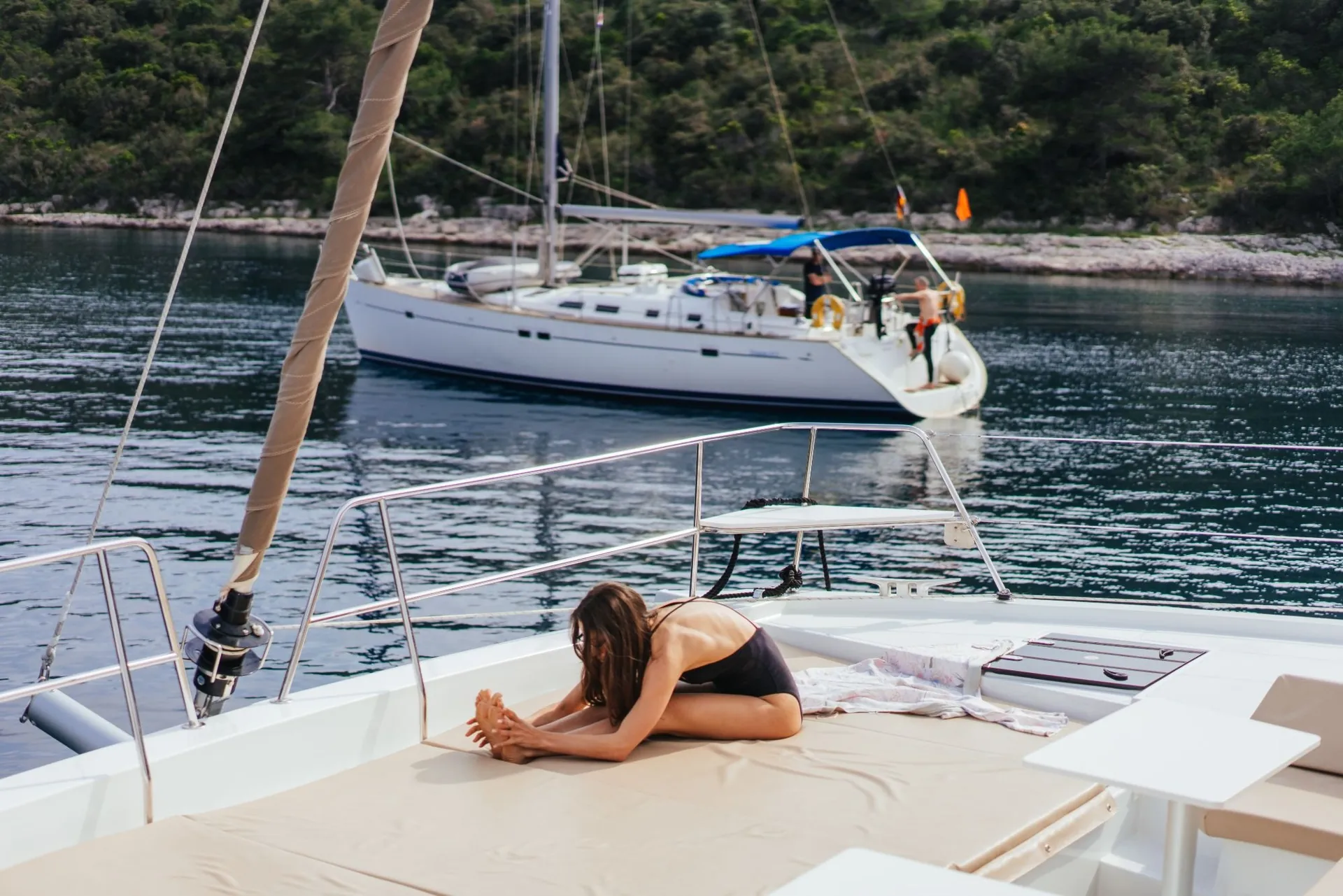
Forward, between the two hulls, many catamarans carry a trampoline: a tightly tensioned woven net that turns the gap between the hulls into a flat area people can move about on. Cruising World calls it a favourite spot on the boat to lounge and relax, and a good place to watch for dolphins under way. It is a natural place to stretch out in the sun after a swim.
At the other end, the sterns of many charter catamarans open into wide transom steps that serve as a swim platform and make it easier to board from a tender. The same designer who explains their purpose also warns how easy it is to slip and fall backwards out of a cockpit that is open at the stern. Both ends of the boat reward the same habits: walk rather than run, hold on when the boat moves, and follow the captain's simple rules for the bow and the swim stops, especially with children aboard. Deck layouts differ from boat to boat, so ask the team how each of ours is arranged forward and aft when you plan.
Sail or power: two kinds of catamaran
Catamarans come in two broad families. Sailing catamarans carry a mast and sails and, when the breeze allows, cross the water in near silence, without engine noise. Power catamarans replace the rig with engines, often with a flybridge where the sail would be, and are faster and roomier for it. Describing one large power catamaran, Boat International listed the advantages of a catamaran as stability and comfort, large guest areas, a low draught and low fuel consumption.
A sailing catamaran has limits of its own. Multihulls do not point as high into the wind as monohulls and tack slowly, so on a sailing day the captain may motor some legs to keep to the plan. If the passage is part of the pleasure, a sailing catamaran fits it well. If you want to cover more coastline between swims, a motor or sport yacht from our fleet usually does that better.
Our two catamarans at a glance
- Catamaran: 15.23 metres long with a 7.43-metre beam, listed for up to 45 guests, with a crew of three and two heads. A paddle surf board and a kayak are always included aboard.
- Catamaran II: our largest day catamaran, 18 metres long and 9 metres across, listed for up to 65 guests, with the same crew of three and two heads, plus paddle surf and snorkelling gear aboard.
Both are sailing catamarans and both run as day catamarans, for a day or an evening at sea. Most of our fleet is listed for 12 guests or fewer per yacht, so the catamarans are the natural way to keep a large party together on one deck. If you would like a longer charter, tell us and the team will discuss the options; for a night aboard, a motor yacht or superyacht with cabins is the usual choice.
Who a catamaran suits
- Large family gatherings across generations, where grandparents and children share one steady deck.
- Birthdays, anniversaries and other celebrations for a big guest list.
- Team days and client events, where the point is having everyone in the same place.
- A day of swimming, paddle surf and kayaking from a stable platform.
- A sunset sail with the whole group together.
For a quieter day for two, a sport yacht keeps things more intimate, and a superyacht brings a full crew to a smaller group.
Planning a catamaran day from Palma
Tell us your final headcount early, because it decides which of the two catamarans fits. Share the occasion, the time of day and any dietary needs too, since catering for a large group is arranged in advance, and the ages of any children, so suitable life jackets can be checked before the day. The team confirms the berth for your dates and proposes a route, for example around the Bay of Palma, Puerto Portals, Port Adriano or Port d'Andratx, and the captain chooses the anchorage on the day for the wind and the rules. Our guide to choosing a day or week charter helps with the format. When you are ready, send your dates, group size and occasion by WhatsApp, email or the form, and we will propose the catamaran that fits.