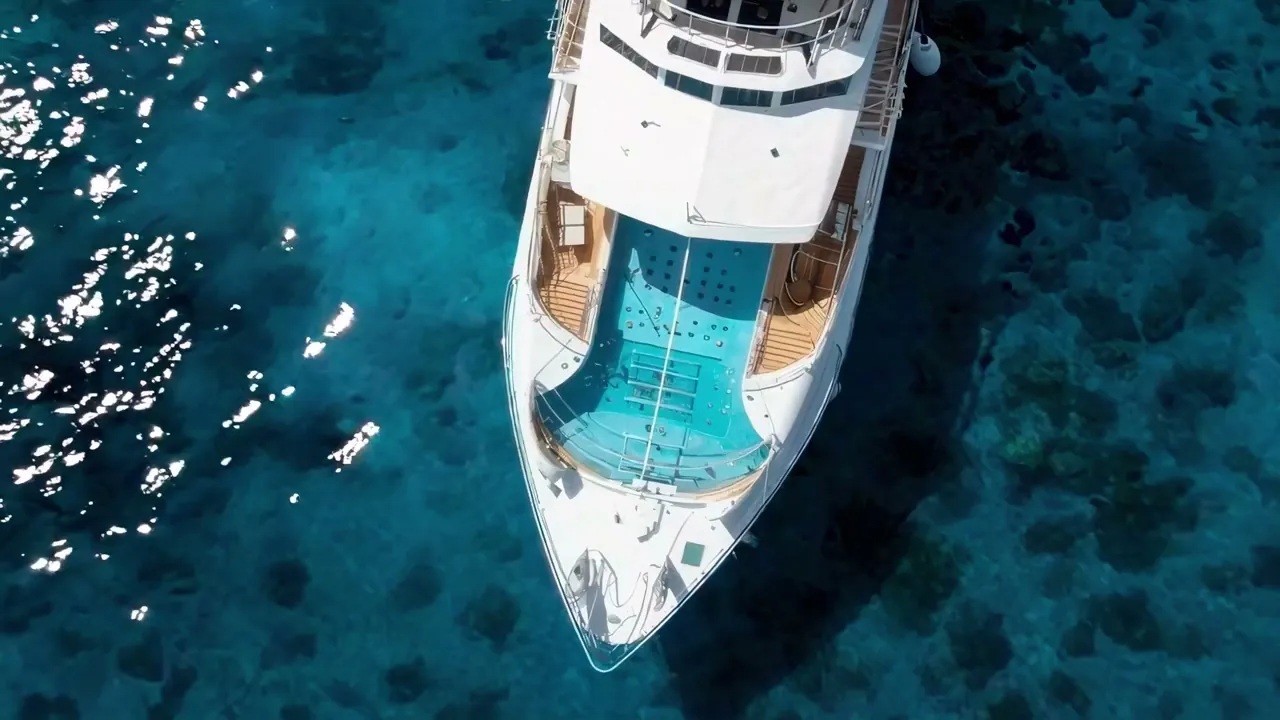
Why captains in the Balearics do not anchor on Posidonia seagrass, how the Posidonia decree and the buoy fields work, and what it means for a day aboard.
Watch a captain arrive in a Mallorcan cove and you will often see the yacht circle slowly before the anchor goes down. The reason is usually a plant. Posidonia oceanica, a seagrass found only in the Mediterranean, covers large areas of shallow seabed around the Balearic Islands, and anchoring on it is generally prohibited. Understanding Posidonia and anchoring in Mallorca explains a great deal about how a well-run yacht charter moves through the day: where the yacht stops, why a captain prefers one bay to another, and why the water in the calas stays so clear. This guide covers what the plant is, what the Balearic rules say, how buoys and Cabrera's permits work, and what it changes for guests on board.
Why Posidonia matters
Posidonia is not seaweed. It is a flowering plant that produces flowers and fruit and grows in dense meadows, often described as underwater forests. The Balearic Government's own guidance sums up its role: the meadows fix CO2 and produce oxygen, give many marine species food, shelter and a place to breed, protect sandy shores from erosion, and produce much of the sediment that ends up as sand on local beaches. The ribbons of dried leaves that sometimes gather along a beach come from the same meadows.
The plant also grows extremely slowly. Its creeping rhizomes advance only a few centimetres a year, so a meadow torn by an anchor and chain recovers very slowly. That is why Posidonia meadows are listed as a priority habitat under the EU Habitats Directive, and why the meadows between Ibiza and Formentera are part of the UNESCO World Heritage site Ibiza, Biodiversity and Culture, inscribed in 1999.
The Balearic Posidonia decree
In the Balearics the key text is Decree 25/2018 of 27 July on the conservation of Posidonia oceanica, published in the Official Gazette of the Balearic Islands (BOIB) the following day. Its core rule is plain: anchoring on Posidonia is prohibited as a general rule. The only way to moor over a meadow is an authorised low-impact system, meaning an individual buoy or a regulated buoy field. Even when the anchor itself lands on sand, the chain and other gear must not reach the meadow nearby.
In meadows the decree classes as high value, no buoys may be installed at all. Surveillance falls to the Balearic Government and its environmental agents, and breaches are administrative infringements under Spanish and Balearic nature protection law, with penalties graded particularly by the area of meadow affected. The exceptions are narrow: force majeure, or danger to human life at sea.
Buoy fields around Mallorca and beyond
In several busy areas the Government has installed regulated buoy fields, where a yacht must moor on one of the installed buoys instead of anchoring. Two are around Mallorca: Sa Dragonera and Sant Elm, off the western tip, and the stretch from Cap Enderrocat to Cap Blanc, including Cala Blava, south-east of Palma. The official list also covers Ses Salines between Ibiza and Formentera, including s'Espalmador, and two areas of Menorca: Fornells Bay on the north coast and Illa d'en Colom in S'Albufera des Grau, in the north-east.
The Government's Posidonia website links to an online booking system, so a buoy can often be reserved in advance. The decree requires buoys to be removed out of season when they are not needed, so the fields mainly operate during the boating months. Where a protected area's own management plan is stricter, that plan applies, which is why a captain checks the local regime as well as the decree.
Cabrera: buoys by authorisation
Cabrera National Park, south of Mallorca, runs its own system. Navigating and mooring there require prior authorisation, requested online, and yachts moor on reserved park buoys. Once issued, a navigation permit is valid for twelve months. The buoys are colour-coded by length and serve boats up to 35 metres, while longer yachts can only be given a special authorisation, granted exceptionally and with prior justification. Numbers are capped: the park allows up to fifty boats to moor each day, with stays limited to two nights in July and August and seven nights in the rest of the year. Summer brings the highest demand, so the authorisation is best arranged well ahead. Our guide to Cabrera by yacht covers the planning in more detail.
How your captain chooses an anchorage
Choosing an anchorage is one of the quiet skills of a good charter captain, and it follows a clear sequence.
- Weather first. Wind and swell decide which coast offers shelter, and so which coves make the shortlist.
- The official map. The Balearic Government publishes its Posidonia cartography on the IDEIB map viewer, and its Posidonia website lists apps such as Posidonia Maps and Donia.
- A look over the side. In clear water, sand shows pale turquoise and Posidonia dark, so the captain confirms the chart by eye.
- Room to swing. A yacht turns with the wind, so the sand patch must be large enough that the chain never sweeps the meadow.
- A buoy where one exists, booked ahead where that is possible.
- A better cove when needed. If a bay is too full to anchor well, the captain moves on rather than squeeze in.
Size changes the picture. A large motor yacht or superyacht needs a bigger patch of sand and more depth, so it often anchors further out in a wider bay and takes guests ashore by tender. A catamaran's shallow draught can let it anchor over sand closer in, always where the rules allow.
What it means for your day aboard
For guests, the rules change surprisingly little. You may notice a few minutes of slow circling, a choice between two neighbouring coves or a short tender ride to a beach. In return you swim in water that healthy meadows help keep clear. A snorkel along the edge of a meadow, where pale sand meets the seagrass, is often the most rewarding swim of the day, with small fish sheltering among the leaves.
If a particular cove matters to you, for a celebration or a favourite beach, tell us when you plan the charter. In high summer the captain may suggest arriving earlier or keeping an alternative in reserve, and Cabrera always needs its authorisation in place before the day.
Every charter with Serman Yacht Charter runs with a professional captain, whether you choose a superyacht, a motor yacht, a sport yacht or a sailing catamaran. Reading the seabed, the weather and the local rules is part of the job, so you can leave the anchoring to the crew and simply enjoy the bay. To start planning, write to us by WhatsApp, email or the contact form.